1. Fampidirana
This manual provides essential information for the safe and effective installation, operation, and maintenance of the LS Industrial UVT-220 Under Voltage Trip. The UVT-220 is an accessory designed for use with LS Industrial Susol UT Series Molded Case Circuit Breakers (MCCBs) to provide under-voltage fiarovana.
It is compatible with UTS150/250A, UTS400/600A, and TD125-TS800 Frame MCCBs.
2. Information momba ny fiarovana
WARNING: Electrical shock hazard. Installation and maintenance should only be performed by qualified personnel.
- Tapaho foana ny herinaratra alohan'ny hametrahana, hikarakarana, na hanesorana ilay fitaovana.
- Ataovy azo antoka fa arahina ny kaody elektrika eo an-toerana sy nasionaly.
- Mampiasà fitaovana fiarovana manokana (PPE).
- Hamarino fa marina ny voltage and current ratings before connection.
- Aza miasa ny fitaovana raha toa ka simba.
3. Vokatra mihoatraview
The LS Industrial UVT-220 is an Under Voltage Trip (UVT) unit designed to automatically trip a Molded Case Circuit Breaker (MCCB) when the supply voltage drops below a predetermined level. This protects connected equipment from damage due to insufficient voltage and ensures safety by disconnecting power during brownouts or power failures.
The unit operates on 220-240V AC or 250V DC.
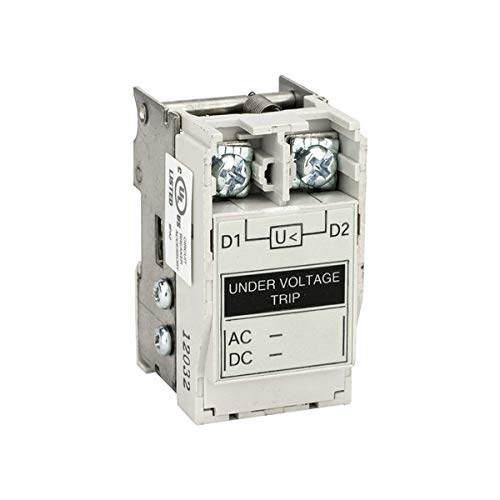
Sary 1: LS Industrial UVT-220 Under Voltage Trip unit. This image shows the compact, rectangular device with two screw terminals labeled D1 and D2, and a label indicating "UNDER VOLTAGE TRIP" along with AC and DC voltage markings. The unit is designed to be integrated with compatible MCCBs.
4. Fametrahana sy fametrahana
The UVT-220 is an internal accessory for compatible LS Industrial MCCBs. Refer to the specific MCCB manual for detailed installation instructions, as the procedure may vary slightly depending on the MCCB frame size and model.
- Fanapahan-jiro: Ensure all power to the MCCB and associated circuits is completely disconnected and locked out.
- MCCB Access: Open the MCCB cover or access panel as per the MCCB's instruction manual.
- UVT Insertion: Carefully insert the UVT-220 into its designated slot within the MCCB. Ensure it is seated correctly and securely.
- Wiring: Connect the control circuit wiring to the terminals D1 and D2 on the UVT-220. Ensure correct polarity for DC applications. The UVT requires a continuous voltage supply to remain in the "set" position.
- Fifandraisana azo antoka: Hamafiso ny visy rehetra amin'ny torque voafaritra.
- Reassemble: Close and secure the MCCB cover or access panel.
- Fitsapana: After installation, carefully re-energize the circuit and perform functional tests to ensure the UVT operates as intended (e.g., simulate an under-voltage condition if safely possible, or verify the MCCB can be manually reset).
Note: Professional installation by a certified electrician is highly recommended.
5. Fitsipika miasa
The UVT-220 continuously monitors the voltage of the control circuit connected to its terminals. When the monitored voltage drops below a factory-set threshold (typically 35% to 70% of the rated voltage, depending on the specific model and standard), the UVT mechanism activates, causing the associated MCCB to trip and open its contacts. This action disconnects the load from the power supply.
The MCCB cannot be reset or closed until the voltage returns to an acceptable level (typically 85% or more of the rated voltage) and the UVT is reset (either automatically or by the MCCB's reset mechanism, depending on the MCCB design).
6. Fikojakojana
The LS Industrial UVT-220 is designed for reliable operation with minimal maintenance. However, periodic checks are recommended to ensure continued functionality:
- Fanaraha-maso maso: Periodically inspect the UVT and its connections for any signs of physical damage, corrosion, or loose wiring.
- Fifandraisana Integrity: Ensure all terminal connections remain tight.
- Fitsapana miasa: If possible and safe to do so, periodically test the UVT's tripping function by simulating an under-voltage condition or using the MCCB's test button (if applicable and designed to test accessories).
- Fanadiovana: Keep the area around the MCCB and UVT free from dust and debris.
Any maintenance or repair work should be carried out by qualified personnel.
7. Famahana olana
This section addresses common issues that may arise with the UVT-220.
- MCCB does not trip on under-voltage:
- Verify the control voltage supply to the UVT terminals (D1, D2) is present and within the specified range.
- Check for loose or incorrect wiring connections.
- Ensure the UVT is correctly installed and seated within the MCCB.
- The UVT unit itself may be faulty and require replacement.
- MCCB trips unexpectedly or cannot be reset:
- Jereo ny famatsiana voltage. If it is below the UVT's tripping threshold, the UVT is functioning correctly. The MCCB cannot be reset until the voltage sitrana.
- Verify the control voltage supply to the UVT terminals (D1, D2) is stable and not experiencing intermittent drops.
- Ensure the UVT is compatible with the specific MCCB model.
- The UVT unit may be faulty and require replacement.
If troubleshooting steps do not resolve the issue, contact a qualified electrician or LS Industrial technical support.
8. Famaritana
| endri-javatra | famaritana |
|---|---|
| MODELY | UVT-220 |
| Marika | LS Industrial |
| Naoty Voltage | 220-240V AC / 250V DC |
| mifanentana | LS Industrial Susol UT Series MCCBs (UTS150/250A, UTS400/600A, TD125-TS800 Frame) |
| ASIN | B07VC3CCJY |
| mpanamboatra | LS Industrial |
Note: Other specifications like Current Rating, Circuit Breaker Type, Mounting Type, and Number of Poles refer to the compatible MCCB, not the UVT-220 accessory itself.
9. Warranty sy fanohanana
For warranty information, technical support, or service inquiries regarding the LS Industrial UVT-220, please contact your authorized LS Industrial dealer or visit the official LS Industrial website. Tehirizo ny tapakila fividiananao ho an'ny fitakiana fiantohana.